Showing posts with label AKC. Show all posts

Wednesday, July 3, 2013

Difference between Parson, Jack Russell and Russell Terrier

By Linda Cole

The Parson, Jack Russell, and Russell terriers are actually three different breeds, even though they're related and look much alike. The Russell Terrier was introduced at the National Dog Show in 2012 as a new breed recognized by the AKC. The Jack Russell is not a recognized breed, despite the dog’s popularity in this country. There is a good explanation as to why, but it can be a bit confusing.

The Parson, Jack Russell and Russell terrier breeds were all named after the Reverend John “Jack” Russell (1795 - 1883), a parson who lived in Devonshire, England during the 1800s. He was an avid fox hunter, when he wasn't attending to his duties at his church. The Reverend was also quite fond of fox hunting dogs, and bred them. His first terrier, a female named Trump, was likely the foundation for Russell's working dogs.

Reverend Russell, also known as “The Sporting Parson,” wanted a working dog that was feisty, strong and confident ,to hunt fox and go to ground to flush out fox or other prey from a hole. The Reverend lived in the southern part of England where the terrain wasn't as hilly, and a short legged dog met his needs. The small dog ran with hunters on horseback, and hounds following a fox. When the hounds chased the fox underground, it was the terrier's job to follow and flush the fox out of the hole so the hunt could resume.

It was after Reverend Russell's death when the JRT breed began to evolve into the Parson Terrier. Hunters living in areas where the land was more uneven and hillier wanted dogs with longer legs that allowed them to better navigate rougher terrain so they could keep up with the hounds and horses. They were also more interested in hunting other prey, primarily badger. If a pup was born with shorter legs, they were kept at home as companion pets, to roam around the barn and home catching vermin, and as watchdogs.

Eventually, it was discovered that the dogs with shorter legs could be useful on a hunt. The dogs were easy to carry over rougher landscape in terrier sacks slung over the hunter's shoulder or across their saddle. And because of their smaller size, it was easier for them to get into smaller dens underground. This is when the Parson and Jack Russell terriers began to split off into two separate breeds.
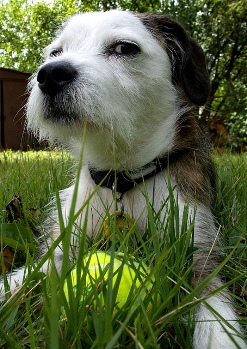
The traditional Jack Russell terrier was created in England, and developed in Australia into the breed we know today. Both the Jack Russell and Parson terriers were bred as working breeds. However, it's the Parson terrier that was bred as a hunting dog with a higher energy level. The Jack Russell terrier was bred more as a companion dog. Although both breeds share the same intensity in prey drive, the JRT understands when it's time to chill out, and they are mellower than their cousin, the Parson terrier.

There are not a lot of differences between the Parson, Jack Russell, and Russell terrier, but all three are considered different breeds, and this is where it can get confusing. The Russell terrier is actually a shorter version of the Jack Russell terrier. Australia and other FCI (an international federation of kennel clubs) countries call the Russell terrier a Jack Russell terrier, which is the traditional old style JRT. In the US, the Russell terrier is the same size as the Australian Jack Russell terrier. Both the Russell and Parson terrier are recognized by the AKC, but the Jack Russell terrier isn't.

The standard height for the Parson is 12 ½ -15 inches, the Jack Russell Terrier is 10-12 inches, and the Russell – also known as the “Shorty JRT” – is 8 -12 inches tall. The Parson is known as the dog with the square body, and both the Russell and JRT have rectangular bodies.

Why isn't the JRT recognized by the AKC? This, too, is a little complicated. The Jack Russell Terrier Club of America (JRTCA) wanted to make sure the breed kept its working dog status. When AKC was considering adding the Jack Russell terrier to their list of recognized dogs in the early 1990s, the JRTCA opposed it, fearing the working ability would be bred out of the breed, with an emphasis placed on conformation over hunting ability. In 2001, the issue was brought up again when the Jack Russell Terrier Breeders Association filed a petition requesting the Jack Russell be recognized as a legitimate breed.

Because there's a variation in the JRT in size and appearance, all Jack Russell terriers that met a specific standard were renamed as Parson terrier. The newly recognized Russell terrier is the same breed as the Jack Russell terrier recognized in Australia and other FCI countries, and the JRT is still not a recognized breed. This seems to have made everyone involved happy, for the time being.

Top photo by Vidar Hoel
Middle and bottom photos by Chris Martin

Read more articles by Linda Cole

Monday, June 17, 2013

Understanding Dog Show Terms

By Suzanne Alicie

Many dog lovers enjoy watching dog shows. We get to see the “top dogs” of each breed, but a lot of us may find ourselves wondering exactly how the judges choose the winners. There are many terms and standards that “show dog” owners are aware of and work to achieve. Let’s take a look at a few of these and what they mean, so the next time you watch a dog show you’ll understand more about the process and have more insight into the final results.

Breed Standard

The breed standard includes several areas of the dog’s appearance which are dictated by the AKC for show dogs. This means that dogs of a specific breed which are the wrong color, have any irregularities or are too large or small for the breed standard won’t be competing. The dogs which have shown that they fit the breed standard will be further evaluated to find the best example of the breed in the show.

Stacking

Stacking is how the dog stands naturally and when placed in position. This is something that the handler or trainer will teach the dog. Stacking helps the judges see all areas of the dog’s structure to evaluate against the breed standard and to allow the judges to feel the dogs bone structure and muscles. The breed standard stacking position differs from breed to breed. While evaluating the stack, you may hear judges and announcers talk about angulations, soundness and pedigree.

Showing the Bite

The bite is the alignment of the top and bottom teeth. Judges check this to compare to the breed standard and in the examination of bone structure. Some dog breeds have a slight under bite, but the best guide is that the teeth should fit together like scissors. Dogs with a bad bite don’t fit the breed standard and are typically not bred for show.

Movement Down and Back

Watching the dog move down and back in front of the judges allows them to evaluate the fit and function of the dog. Stacking is an up close examination, while movement down and back is a chance to see all the parts of the dog working together. Movement down and back is judged on the gait of the dog, heeling, and relation to the location of the handler while proceeding.

While many of us just enjoy watching beautifully groomed and well behaved dogs in dog shows, there is a great deal of time, training and preparation put into each appearance. Trainers work with show dogs daily to teach them proper comportment, improve their gait, their stance and of course their willingness to stand perfectly still while being examined by strangers.

As the owner of a dog who absolutely would not go for that, I am always amazed at the wonderful behavior show dogs exhibit. They are truly the top of their breeds, with excellent training, grace and athleticism.

There are other types of shows and competitions for dogs, including agility competitions, puppy competitions, specialty shows and obedience shows. Here on the Responsible Pet Ownership blog we have interviewed and explored many aspects of working and show dogs, their owners and the competitions and shows they participate in. CANIDAE Natural Pet Foods is proud to sponsor several exemplary show dogs and talented canine athletes.

If you’d like to learn more, check out these posts:

What Westminster Dog Show Champions Do After the Big Win 

What is a Conformation Dog Show? 

How to Train Your Dog for Agility Competitions 

CANIDAE Sponsored Dogs Make a Splash at “Paws in the Pool” 

Top photo by mjk23
Bottom photo by Natalie Maynor

Read more articles by Suzanne Alicie