Showing posts with label working dogs. Show all posts

Tuesday, August 27, 2013

How Archaeologists Use the Power of a Dog's Nose

By Linda Cole

Dogs are famous for their acute sense of smell. Beagles have been employed as bed bug detection dogs, and they sniff bags in airports to check for illegal fruits and vegetables being brought in by travelers. Drug and bomb sniffing dogs are trained to detect the smallest hint of contraband or explosives. More recently, archaeologists have discovered a dog with a good nose can be trained to search for smells that will tell us about our historical past buried in prehistoric grave sites. Now that's a dog with a keen sense of smell!

When comparing scent receptors, we humans are woefully inadequate to dogs. Humans have around five million scent receptors in their nose, and the average canine has around 200 million. Adding to a dog's extraordinary scenting ability is an organ located on the roof of the mouth that allows them to “taste” a smell, as well. So when we catch a whiff of steaks grilling on a BBQ close by, you can imagine how that mouth-watering scent is affecting your dog. Dogs are also capable of honing in on one specific smell among many. Once they find what they're looking for, their focus is on that one smell, and they can follow it to its source. That's why it's nearly impossible to evade a tracking Bloodhound.

Historical Human Remains Detection dogs (HHRD) are trained to sniff out lingering odors from bones and teeth in old grave sites, some that may be thousands of years old. These unique canines are the newest detection dogs, and they help humans search for information underground that is difficult for us to find on our own. These specially trained dogs have been used by archaeologists, construction companies and ordinary people to locate American Indian burial sites, lost family cemeteries and unmarked grave sites.

We live in the present, but our history is buried in the past. We learn who we are as a people by understanding who we were in the past. Spread across this land are historical and prehistoric grave sites that can take us back to another time. In many cases, finding a hundred-year-old family burial spot isn't of any real value to most people, but it is to the family searching for their roots.

Prehistoric bones found in a site somewhere out west may not be of particular interest to the average person, but it could reveal another clue to someone's ancestral history. Our buried history is spread out across the country as this land was settled by pioneers. Finding these burial sites, especially ones with historical value, allows archaeologists to preserve another part of our past before it's covered over by a highway, parking lot or office building.

The advantage of using dogs to detect odors beneath the ground is that it's a non-evasive method, and it can save time and money. Instead of having to search an entire field to find ancient bones, the dogs are quickly able to pinpoint a location. Along with other searching tools, like ground penetrating radar equipment, a search team has a better idea of where to focus their attention. Dogs have been used a lot on the West Coast to identify sacred Native American burial grounds before an area is developed.

These bone sniffing dogs have been helping researchers find evidence to piece together the tragic story of the Donner Party who in 1846 found themselves trapped in the worst snowstorm to hit the Sierras. Only 40 people out of 81 survived. The dogs were able to pinpoint other possible campsites that had been missed by archaeologists, and find small bones that can be identified if current family members can supply DNA.

A Historical Human Remains dog named Nessie worked with archaeologists excavating a Neolithic Age site from 5000 BC located in Prague, Czech Republic. The Border Collie also located previously undetected graves dating back to 450 A.D. on a construction site in another part of Prague.

Because a dog's nose is so powerful, law enforcement officials and archaeologists have discovered a canine can locate a grave site much faster than they can, and the dogs have established an impressive record for being right. Finding ancient burial grounds, unmarked graves from years past, or long lost family cemeteries is important to the people searching. And it's a job only a dog can do, because of his incredible and powerful nose!

Top photo by cursed thing
Bottom photo by Peter Corbett

Read more articles by Linda Cole

Wednesday, July 3, 2013

Difference between Parson, Jack Russell and Russell Terrier

By Linda Cole

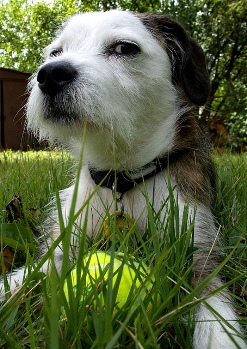
The Parson, Jack Russell, and Russell terriers are actually three different breeds, even though they're related and look much alike. The Russell Terrier was introduced at the National Dog Show in 2012 as a new breed recognized by the AKC. The Jack Russell is not a recognized breed, despite the dog’s popularity in this country. There is a good explanation as to why, but it can be a bit confusing.

The Parson, Jack Russell and Russell terrier breeds were all named after the Reverend John “Jack” Russell (1795 - 1883), a parson who lived in Devonshire, England during the 1800s. He was an avid fox hunter, when he wasn't attending to his duties at his church. The Reverend was also quite fond of fox hunting dogs, and bred them. His first terrier, a female named Trump, was likely the foundation for Russell's working dogs.

Reverend Russell, also known as “The Sporting Parson,” wanted a working dog that was feisty, strong and confident ,to hunt fox and go to ground to flush out fox or other prey from a hole. The Reverend lived in the southern part of England where the terrain wasn't as hilly, and a short legged dog met his needs. The small dog ran with hunters on horseback, and hounds following a fox. When the hounds chased the fox underground, it was the terrier's job to follow and flush the fox out of the hole so the hunt could resume.

It was after Reverend Russell's death when the JRT breed began to evolve into the Parson Terrier. Hunters living in areas where the land was more uneven and hillier wanted dogs with longer legs that allowed them to better navigate rougher terrain so they could keep up with the hounds and horses. They were also more interested in hunting other prey, primarily badger. If a pup was born with shorter legs, they were kept at home as companion pets, to roam around the barn and home catching vermin, and as watchdogs.

Eventually, it was discovered that the dogs with shorter legs could be useful on a hunt. The dogs were easy to carry over rougher landscape in terrier sacks slung over the hunter's shoulder or across their saddle. And because of their smaller size, it was easier for them to get into smaller dens underground. This is when the Parson and Jack Russell terriers began to split off into two separate breeds.

The traditional Jack Russell terrier was created in England, and developed in Australia into the breed we know today. Both the Jack Russell and Parson terriers were bred as working breeds. However, it's the Parson terrier that was bred as a hunting dog with a higher energy level. The Jack Russell terrier was bred more as a companion dog. Although both breeds share the same intensity in prey drive, the JRT understands when it's time to chill out, and they are mellower than their cousin, the Parson terrier.

There are not a lot of differences between the Parson, Jack Russell, and Russell terrier, but all three are considered different breeds, and this is where it can get confusing. The Russell terrier is actually a shorter version of the Jack Russell terrier. Australia and other FCI (an international federation of kennel clubs) countries call the Russell terrier a Jack Russell terrier, which is the traditional old style JRT. In the US, the Russell terrier is the same size as the Australian Jack Russell terrier. Both the Russell and Parson terrier are recognized by the AKC, but the Jack Russell terrier isn't.

The standard height for the Parson is 12 ½ -15 inches, the Jack Russell Terrier is 10-12 inches, and the Russell – also known as the “Shorty JRT” – is 8 -12 inches tall. The Parson is known as the dog with the square body, and both the Russell and JRT have rectangular bodies.

Why isn't the JRT recognized by the AKC? This, too, is a little complicated. The Jack Russell Terrier Club of America (JRTCA) wanted to make sure the breed kept its working dog status. When AKC was considering adding the Jack Russell terrier to their list of recognized dogs in the early 1990s, the JRTCA opposed it, fearing the working ability would be bred out of the breed, with an emphasis placed on conformation over hunting ability. In 2001, the issue was brought up again when the Jack Russell Terrier Breeders Association filed a petition requesting the Jack Russell be recognized as a legitimate breed.

Because there's a variation in the JRT in size and appearance, all Jack Russell terriers that met a specific standard were renamed as Parson terrier. The newly recognized Russell terrier is the same breed as the Jack Russell terrier recognized in Australia and other FCI countries, and the JRT is still not a recognized breed. This seems to have made everyone involved happy, for the time being.

Top photo by Vidar Hoel
Middle and bottom photos by Chris Martin

Read more articles by Linda Cole

Thursday, May 23, 2013

The Highest Paid Animal Actors

Rin Tin Tin in the 1929 film Frozen River

By Langley Cornwell

Animals don't really care about money, but nevertheless, when it comes to animal actors, they do indeed get paid. Some animal actors receive a hefty fee for their performances, and that pay would make any human drool. Who are the highest paid animal actors? Check these out.

Rin Tin Tin the Dog 

This beloved pooch starred in 26 films for Warner Brothers and commanded a cool $6,000 each week. In today's money, that would equal $78,000 per week! With that income, he could feed himself and thousands of his friends a healthy diet of CANIDAE dog food. Rin Tin Tin earned Warner Brothers so much money, in fact, that he was responsible for bringing the studio back from the brink of bankruptcy in 1930. Rin Tin Tin was a German shepherd dog that was rescued from a battlefield during World War I by an American soldier named Lee Duncan. Duncan trained "Rinty," his pet name for his dog. Rin Tin Tin became a beloved movie icon and was rumored to have received the most votes for the Academy Award for Best Actor in 1929, but the Academy would only give the award to a human. The original Rin Tin Tin died in 1932. (Read more about this famous animal actor in The True Story of Rin Tin Tin).

Keiko the Whale

This killer whale made a killing financially, thanks to his depiction of Willy in the Free Willy films. He earned a grand total of over $36 million for his role! Eventually, Keiko gained his own freedom in 2002, as he was returned to the open ocean. Sadly, Keiko died in 2003 in Norway from a bout with pneumonia, but his work lives on after his passing.

Bart the Bear

This big guy starred in a number of roles in the 80s and 90s, and was reportedly paid $1 million for his work in the movie The Edge. Bart was an Alaskan brown bear of the Kodiak bear subspecies. He starred in movies such as The Great Outdoors with John Candy and Dan Aykroyd, and Legends of the Fall with Brad Pitt. He earned more than $6 million during his entire career but passed away in 2000 from cancer at the age of 23.

Pal as Lassie
Pal the Dog

Pal was the first canine to play Lassie the hero dog on the big and small screen, and earned as high as $4,000 per week. Today, that would equal a whopping $51,000 per week! Woof-woof! Pal lived until the ripe old age of 18, but passed away in 1958. He sired a long line of Rough-Coat Collies that would follow in his footsteps by portraying the legendary Lassie. (Read more about Lassie in How Lassie Became One of the World’s Most Popular Dogs).

Moose the Dog 

Moose, a Jack Russell Terrier, played Eddie in the television series Frasier, and reportedly earned $10,000 per episode during his time on the show. As he became older, his son Enzo eventually took over the role. Moose passed away from natural causes in 2006 at the age of 15.

Crystal the Monkey

Perhaps the highest paid animal actor in today's times is Crystal the Monkey. Crystal is a Capuchin monkey and has starred in television and more than 20 feature films. You may recognize Crystal from The Hangover Part II and Night at the Museum. But for starring in the television series Animal Practice, this monkey was set to earn the sweet sum of $12,000 per episode or $264,000 for a full season. Not too shabby for a 20-year-old monkey! Unfortunately for Crystal, Animal Practice was canceled due to low ratings, but the monkey shouldn't have to worry as she seems to have plenty of work available to her.

Animal actors certainly earn their pay as they have to be trained to recognize cues and instructions. While most of these high paid animal actors have passed on, their legacies and memories remain.

Read more articles by Langley Cornwell

Monday, May 6, 2013

Terrier Dog Breeds: Big Attitudes in Small Bodies


Airedale Terrier
By Linda Cole

The terrier group of dog breeds is an interesting mix of canines, bred to do a variety of jobs from hunting prey to keeping rats at bay. They are feisty, energetic and small enough to fit into any home. This is a group with a variety of distinct personalities, but all have a “big attitude in a small body.” Digging is common in terriers because they were bred to go underground after their prey. Terra is the Latin word for “earth,” and terriers are certainly “earth dogs.” The American Kennel Club recognizes 29 different terrier breeds. Here is brief information on nine of them:

The Airedale Terrier holds the “King of Terriers” crown; they are the largest and most robust of the group. The Airedale is considered an all purpose dog, and was used during wartime as a guard dog, to run messages, control rodents, and as a hunting dog. Hypoallergenic; they stand 22-24 inches and weigh 40-64 pounds.

The Australian Terrier was the first breed recognized in 1868 as native to Australia. His job was to work alongside his owner in the Australian Outback to keep vermin and snakes in check. He was also a watchdog, and helped with livestock. Hypoallergenic; they stand 9-11 inches and weigh 12-16 pounds.

Bedlington Terrier
The Bedlington Terrier could easily be mistaken for a lamb because of his woolly, curly coat. The breed was developed in a mining shire in Northumberland, England, and that's where its name comes from. The miners used the Bedlington to control vermin, and because they had excellent speed and endurance, miners also raced them. Hypoallergenic; they stand 15-18 inches and weigh 17-23 pounds.

The Border Terrier can get into most any size hole, and can race across different types of terrain after his main prey, the fox. The Border was bred as a working dog and protector of his owner's livestock. In the old days living on a farm, this little dog had to be a good hunter because he had to hunt down his own supper. Hypoallergenic; they stand 11-16 inches and weigh 11-16 pounds.

Cairn Terrier
The Cairn Terrier takes its name from rock dens called “cairn” where fox and badger live in the Scottish Highlands. The breed originated in the highlands and the Isle of Skye. Toto, Dorothy's little dog in “The Wizard of Oz” was a Cairn Terrier. One of the oldest of the terrier breeds, the Cairn was bred to control vermin. Hypoallergenic; they stand 9-13 inches and weigh 13-18 pounds.

The Cesky Terrier originated in the Czech Republic, and is considered one of the country's national breeds. The Cesky (pronounced chess - key) was bred to work in packs to hunt fox, ducks, pheasants, rabbits and wild boar. This breed is so revered in its native homeland that it has been featured on postage stamps, TV, in books and in a movie. Hypoallergenic; they stand 10-13 inches and weigh 16-22 pounds.

The Dandie Dinmont Terrier definitely has a big dog attitude packed inside his low and long body. This breed was recorded as a distinct breed as far back as 1700, and made his home with rich people and gypsies. Bred to hunt otter and badger, he has a reputation as a skilled hunter, able to go to ground after his prey. The breed was named after a character in a Sir Walter Scott 1814 novel, “Guy Mannering.” Hypoallergenic; they stand 8-11 inches and weigh 18-24 pounds.

The Glen of Imaal Terrier is native to Ireland, bred to control vermin on farms, and hunt fox and badger. This breed has remained pretty much the same today as it was 100 years ago. This dog was also designed to do a rather unique job: they were used to turn a large wheel called a turnspit. As the dog paddled the wheel, it turned a spit over a fire, earning them the nickname of “turnspit dogs.” They stand 12 ½ inches and weigh around 35 pounds.

Kerry Blue Terrier
The Kerry Blue Terrier is an all purpose working dog, bred in County Kerry, Ireland in the 1700s. Their name comes from the area they were bred in, and their coat color. They were used to hunt small game and birds and retrieve them from water and land. The dog also herded cattle and sheep, guarded homes and did police work. Peasants used the Kerry to hunt silently within a nobleman's hunting grounds. The Kerry Blue is born black, and his blue coat doesn't appear until he's between 9 months to 2 years old. Hypoallergenic; they stand 17-20 inches and weigh 33-40 pounds.

The rest of the terrier group includes the American Staffordshire Terrier, Bull Terrier, Irish Terrier, Lakeland Terrier, Manchester Terrier, Miniature Bull Terrier, Miniature Schnauzer, Norfolk Terrier, Norwich Terrier, Parson Russell Terrier, Russell Terrier, Scottish Terrier, Sealyham Terrier, Skye Terrier, Smooth Fox Terrier, Soft Coated Wheaten Terrier, Staffordshire Bull Terrier, Welsh Terrier, West Highland White Terrier and Wire Fox Terrier.

Airedale Terrier by Lulu Hoeller
Bedlington Terrier by Pets Adviser  
Cairn Terrier by Living in Monrovia
Kerry Blue Terrier by pw95

Read more articles by Linda Cole

Friday, April 12, 2013

Paintings of Animal Heroes

Freddy

By Sue Hains

In the winter of 2009 - 2010, I was commissioned to paint a picture of Freddy, an FBI dog who had been killed in service. In preparation for working on the portrait, I was sent a photo of Freddy but required other pictures of Belgian Malinois, Freddy’s breed, since some details in his photo were unclear. Searching online, I began to learn about service animals and discovered that Belgian Malinois are often chosen to become Military Working Dogs and police dogs. As I painted, I received emails about Freddy’s life, death and memorial service, and thought more and more about the life of this heroic animal.

Freddy was born in 2007, and served with the FBI from September 8, 2008 to October 28, 2009. The FBI had raided a warehouse being used as a mosque in Dearborn, Michigan, looking for several of its members who were wanted for a number of crimes. The Imam, who had a criminal record and refused to surrender, shot the FBI dog, Freddy, before the Imam himself was fatally shot by agents. Freddy was helicoptered to a veterinary hospital in Detroit, and although the doctors did everything they could to save his life, the wounds were fatal.

At his memorial service in Virginia, local police motorcycle officers escorted Freddy’s flag-draped casket to the FBI Academy, where the FBI Chaplain gave a moving invocation and where K-9 Police Officers and their dogs stood at attention behind a large crowd which included the veterinarians who tried to save his life. Other speakers followed and it was said that Freddy not only fit in with his team but also saw the humans as his pack!

The brass plaque added to the portrait I painted of Freddy reads:

FREDDY

February 17, 2007 - October 28, 2009
Then I heard the voice of the Lord
saying, "Whom shall I send?  And
who will go for us?"  And I said,
"Here am I.  Send me!"
Isaiah 6:8

I love all animals and Freddy’s story made me cry, but later it made me take action. I decided to paint the portraits of animals that had saved human lives and to then give the paintings to the animal’s companion for free. I looked online for reports of animal heroism and wrote perhaps a dozen letters or emails to reporters
who had written stories of animal heroism or to people who told of owing their lives to an animal. I got no responses. In time, I read an account of a blind cat who – in the middle of the night – had chased an intruder out of his human’s home! I wrote, stating my mission, my belief that this tiny cat qualified as a hero, and asked for permission to paint its portrait. Gwen Cooper emailed in return, saying she would be delighted to have her cat Homer’s portrait painted. (Read her book “Homer, the Blind Wonder Cat”).

Homer
As I worked on Homer’s painting, I continued my online search for hero animals and began to focus on Military Working Dogs, since I was learning about their history in the US. Beginning in 1942, some 10,000 dogs, many donated by their patriotic owners, spent eight to twelve weeks being trained as sentry, scout, messenger or mine detection animals. Several dogs were recognized for their outstanding service and received medals, which were later revoked when it was decided animals should not receive medals.

During the Vietnam War, there were approximately 4000 MWDs, who saved an estimated 10,000 human lives. Estimates of the number of MWDs killed in action range from 232 - 281. When Americans left Vietnam, the war dogs were considered “expendable equipment” and either turned over to the South Vietnamese as war surplus or euthanized, making this war the only one fought by the US in which the surviving MWDs did not come home. Eventually, veteran dog handlers, who shared a strong bond with their working companions, successfully lobbied Congress to approve a bill allowing MWDs to be adopted after service, and President Clinton signed it into law in 2000.

Anax
The online searches put me in touch with Kevin Hanrahan, a writer, soldier and dog advocate who blogs about today’s MWDs. Of some 600 dogs who trained for months to serve in Iraq and Afghanistan in 2011, 116 died in service. Kevin introduced me to the handler of one, Anax, who lost a leg during a firefight – but not his life, thanks to his handler, Marc. (Please read Kevin’s blog for the amazing and touching story of Marc and Anax). I asked Marc for permission to paint the dog he has now adopted, and am pleased to show you my portrait of Anax.

I continue to look for hero animals and am presently painting another MWD which will be followed by a portrait of another FBI dog killed in the line of duty.

***
Self-taught artist Sue Hains began painting at the age of seven, with a gift of paints from her grandfather. Inspired by the surfaces and forms she observes in nature (she received her BA in Natural History), she creates illusions of stone, animals and plant life which range from highly stylized geometric patterns to photo realism.

Sue is currently concentrating on commissioned portraits of pets and other animals and on her mission to paint hero animals. Her work has been featured on KLRU's "Central Texas Gardener," in the Home Builders Association of Greater Austin 2007 "Parade of Homes," as a contributor to the Georgetown, Texas mural on the square, and has won recognition in online art competitions in 2012 and 2013.